
Uniqueness of the Mind Mirrors
The Mind Mirror is an electroencephalograph (EEG) which was first designed
in 1976. It performs frequency analysis of signals generated by the brain and
displays the results on horizontal barographs as a bilateral hemispheric display.
The display panel has two columns of bar graphs which represent the left and
right
hemispheres
(LH,
RH)
of the
brain. The zero signal is displayed by all the indications showing at the middle
of the display. Each bargraph represents one filter; if a LH signal is being
displayed, the indication moves away from the center of the panel to the left
and if a RH signal it moves away from the center of the panel to the right.
The filters which analyze the brain signals are centered on frequencies chosen
to give optimum analysis. These are 0.7Hz, 1.5Hz, 3Hz, 4.5Hz, 6Hz, 7.5Hz, 9Hz,
10.5Hz, 12.5Hz, 15Hz, 19Hz, 24Hz, 30Hz, and 38Hz. These frequencies were initially
chosen by emperical experience and after some early adjustments with the
first Mind
Mirror have been kept the same.
The
bandwidth
of
each filter is adjusted so that the 3db loss points coincide with the equivalent
points
in the adjacent filters. This
means that a brain rhythm whose frequency lies mid-way between two filters will
appear at
a reduced level in both. This disadvantage is balanced by the fact that a signal
lying
between two filters will not be lost.
The performance of the initial analogue filters was excellent, the rejection
of
unwanted signals is 50db per octave. Translated, this means that the response
of the 9Hz
filter
to a 4.5Hz
signal is reduced by a factor of more than 100 times.
These machines and filter frequencies were the basis of the early work in "consciousness" research
by C Maxwell (Max) Cade and its more recent development by Anna Wise.
Brain rhythms respond in both amplitude and frequency to changing thought patterns.
Indeed if any frequency is very stable, it seems to indicate a rigid thought
pattern which can manifest as a seizure. Cade & Blundell's work suggests, for
example, that the alpha frequency of a well-developed subject (someone who is
very good
at
what they do) may average 9Hz but may be varying between 7 and 10Hz. This seemed
to be true of all the subjects who excelled: what they excelled at did not seem
to be important. They could be yoga teachers,
television presenters or healers.
The original analogue filters in Mind Mirrors 1 and 2 were precise but expensive
to manufacture.
The digital Band Pass filters parameters were modeled on the band pass charactersitics
of the analogues filters, and were able to more accurately guarenetee the performance
of the filters.
FFT Analysis of Brainwaves
In the early days there was a lot of discussion about the using
Fast Fourier Transforms (FFT), which are easy to implement in
computer
software.
Due to
the way it
functions,
this
method gives a different pattern to that seen on the Mind Mirror and is not
very responsive to the grouping of bands of frequencies known as the beta,
alpha, theta and delta responses for a variety of reasons.
Fourier transforms assume an infinite long signal, and the Fast Fourier Transform
approxiamates this to about 10full cycles.
The FFT is very good when the signal:
- is a constant frequency
- is repetitive
- is a much higher frequency than the sampling window interval
- linear frequency bins are needed.
An example of its use is the multi-frequency tone recognition used by older analoge telephone signallin, or radar pulses.
The signal to be analyzed must be of a higher frequency than the sampling
window time, i.e., a delta signal of 1Hz cannot be captured (a change of the
signal in 1 second) by a sampling window which lasts one second without gross
errors occurring. Any system with 1Hz window will be inaccurate below about
3 or 4 Hz.
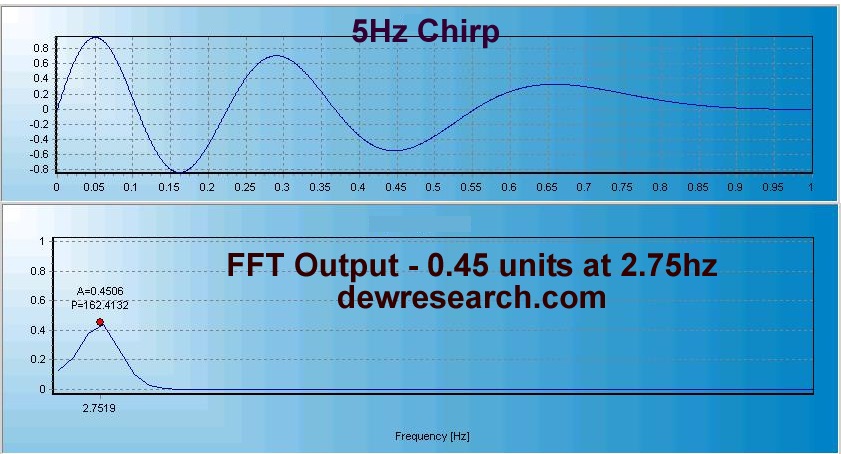
Visually this can be shown with a "5Hz chirp" simulating an EEG signal. The resultant FFT output is at 2.75Hz with a 0.45output. (thanks to the website dewresearch.com which was used to simulate this signal and output)
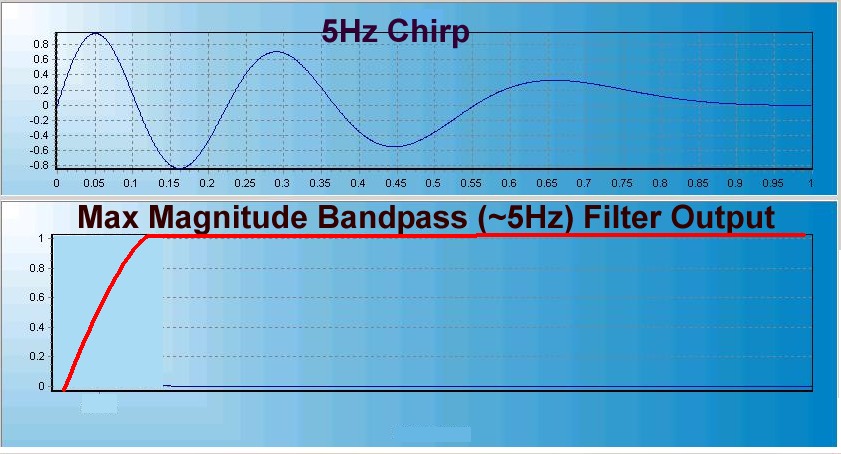
Using band pass filters, for a "5Hz Chirp" into an optomized band pass filter - the output below is a sketch of the observed result. That is the filter with its group delay passes the inital peak of the sine wave chirp and a peak detection function detects the maximum amplitude of the 5Hz chirp.
A characteristic of FFT is that it can only generate outputs
which are distributed linearly in frequency. If for EEG analysis the window
is
chosen
as 1 second,
the frequency "bins" are
1Hz wide from 1 to 40Hz. The relative width of each bin falls with frequency,
i.e. from 1 to 2 Hz is a whole octave wide whereas from 39 to 40Hz is only
a fraction of an octave. This does not matter if the signal consists of
a single tone but when the source is an EEG which is varying continuously
in
frequency,
then this unavoidable change in the relative bandwidth provides another
explanation why the beta response is very different with FFT. FFT does
not respond accurately
to varying or chirpy signals. This is important when reading
alpha frequencies which are rarely very steady in amplitude.
If the beta amplitude is large enough, FFT can generate beta readings which
are approximately accurate, but the method becomes more and more inaccurate
as the beta amplitude reduces. This makes it impossible to use to display
Mind Mirror patterns.
To summarize FFT signal analysis:
- The pattern shown by an FFT analyzer is sufficiently different to make
it unusable for Mind
Mirror work. - The process is not very responsive to changing signals such as alpha.
- The FFT analysis itself produces spurious signals which are not present
in the original. A
correction for this problem causes inaccuracy elsewhere
Uniqueness of the Mind Mirror Pattern.
Anna Wise has been contacted by many frustrated users of FFT systems wondering
why they could not see the patterns which she described in her book The High
Performance Mind. She says:
"Twenty years’ work with the Mind Mirror has led me to understand
the uniqueness of its pattern display and the complexity of the information
I gain
from it.
People need to know that they do not gain the same information from FFT systems
and not realizing its limitations, could lead them to dismiss their own abilities
and/or dismiss my years of research as not being replicable."
"Accessing
alpha allows the flow of information from the unconscious (delta), through
the subconscious (theta), to the conscious (beta) mind. It is this openness
or availability of awareness on all levels that constitutes the state Max Cade
called an
Awakened Mind. Applying and using and manifesting with this open flow of
conscious awareness gives us a High Performance Mind. We have to focus on,
find, and
thoroughly develop the alpha bridge to allow this to happen."
Geoff Blundell's conclusion: "All the
original studies of healers, swamis and anyone who excelled at their job
by Max Cade and myself described in his book The Awakened Mind were performed
with the Mind Mirror using band pass filters and will not be replicable with
an FFT system. "
For anohter part of the uniqueness of the way the Mind Mirror decodes EEG
see Contact
Placement.